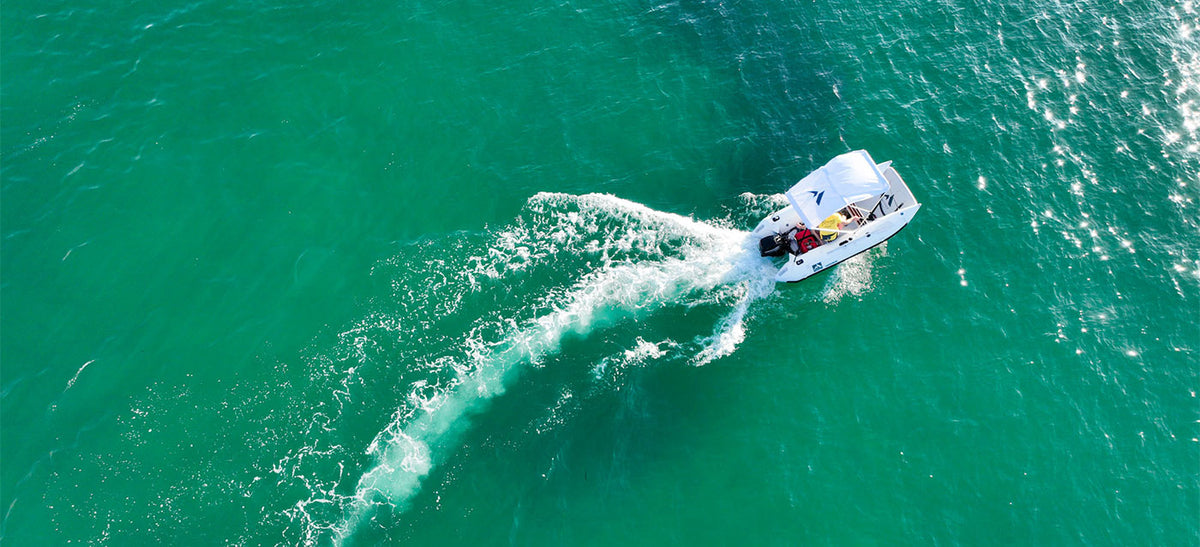
Learn how an open-bow catamaran glides over waves for a stable, surprisingly dry ride.
How does an inflatable catamaran handle waves compared to a traditional inflatable boat? While the open bow may look like it would let water in, the opposite is often true. The highly buoyant twin bows are designed to rise and glide over approaching waves rather than cut through them, creating a remarkably dry and stable ride. Proper weight distribution and throttle control help keep the bow elevated, allowing an inflatable catamaran to comfortably navigate waves, chop, and changing water conditions.
Does it Take Water Over the Bow?
One of the most common questions about inflatable catamarans is how they handle waves, chop, and surf compared with a traditional inflatable boat. Because a catamaran has an open bow between its two tubes, many first-time buyers naturally assume that waves will enter through the front and make for a wet ride.
In practice, the opposite is often true. When operated properly, an inflatable catamaran can provide an exceptionally dry and stable ride because its buoyant twin bows are designed to rise and glide over approaching waves rather than penetrate directly through them.
Understanding why starts with looking at how a catamaran and a traditional V-hull interact with waves.
Inflatable Catamaran vs. Traditional V-Hull in Waves
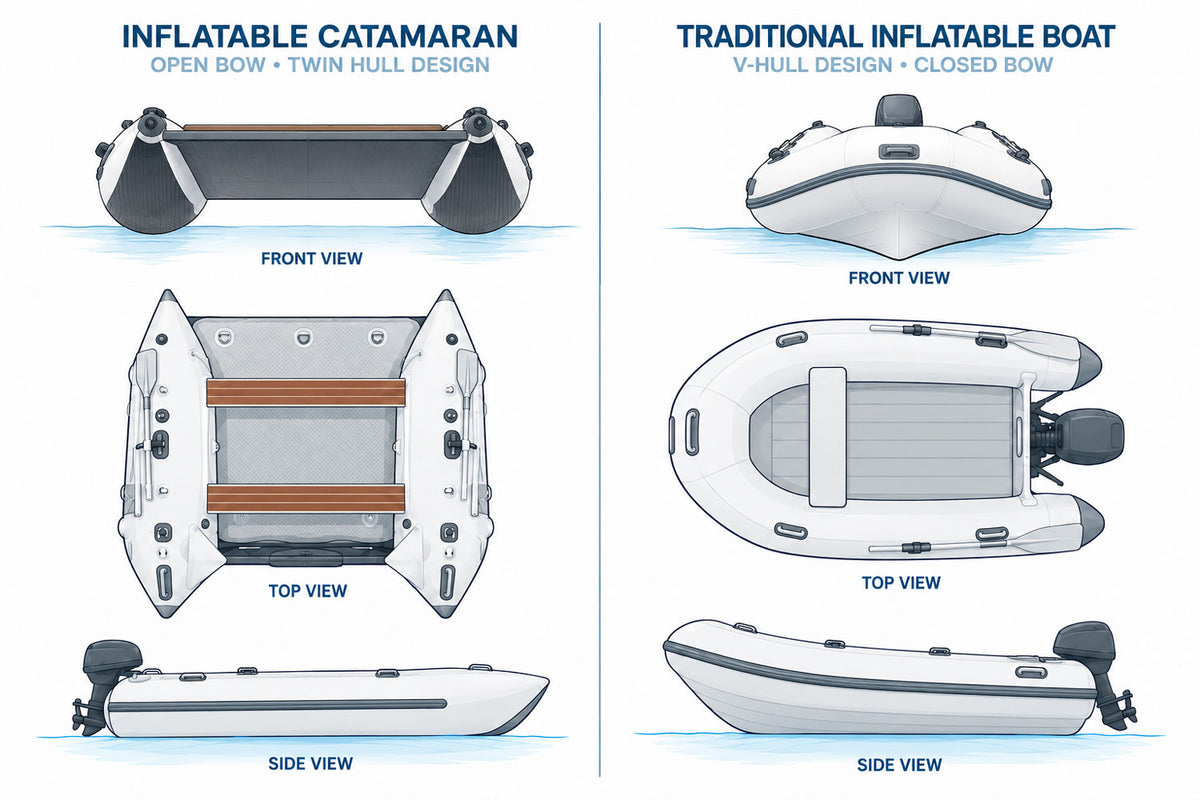
A traditional V-hull inflatable boat is designed to cut into a wave and displace water outward along either side of the hull. This allows the bow to penetrate the face of the wave rather than simply climbing over it, which can reduce the amount of up-and-down movement when traveling through chop.
The tradeoff is that the bow makes more direct contact with the water. If the boat encounters a steep wave without enough speed or bow lift, water and spray can be pushed upward and occasionally over the bow. This is one reason passengers seated toward the front of a conventional inflatable dinghy may experience a wetter ride in certain conditions.
An open-bow inflatable catamaran behaves differently.
The Stern Lifts like a Sled
How an Inflatable Catamaran Rides Over Waves
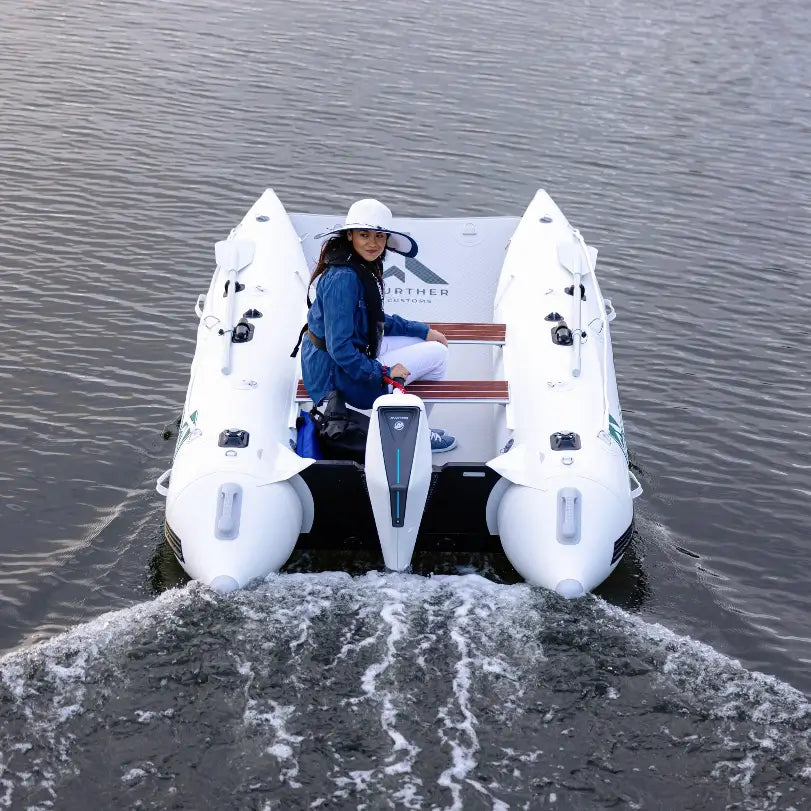
Rather than relying on a center V to cut through the water, an inflatable catamaran uses two highly buoyant outer tubes. As the bow encounters a wave, the tubes generate lift and encourage the boat to rise over the face of the wave.
The sensation is somewhat like a sled traveling over uneven terrain. Instead of penetrating deeply into each wave and pushing water outward, the catamaran tends to climb the face, pass over the crest, and descend the other side.
This can create more noticeable up-and-down movement or undulation in closely spaced chop, but it also has an important benefit: a remarkably dry ride.
Will Water Come Through the Open Bow of an Inflatable Catamaran?
This is perhaps the most common concern and misconception about open-bow inflatable catamarans. At first glance, it seems logical that an open bow would allow waves to enter the boat and get passengers wet.
Under normal operating conditions, however, the catamaran hull works to prevent exactly that.
The large volume of air in the twin bow tubes provides substantial buoyancy. When the boat meets an approaching wave, the bows naturally want to rise and glide over it. Instead of presenting a broad center bow that penetrates the wave and throws water outward, the catamaran rides up and over the surface.
As a result, an open-bow catamaran can actually provide a drier ride than many traditional inflatable boats, particularly when traveling through rolling waves and moderate chop.
The key is operating the boat correctly.
How Does an Inflatable Catamaran Handle Chop?
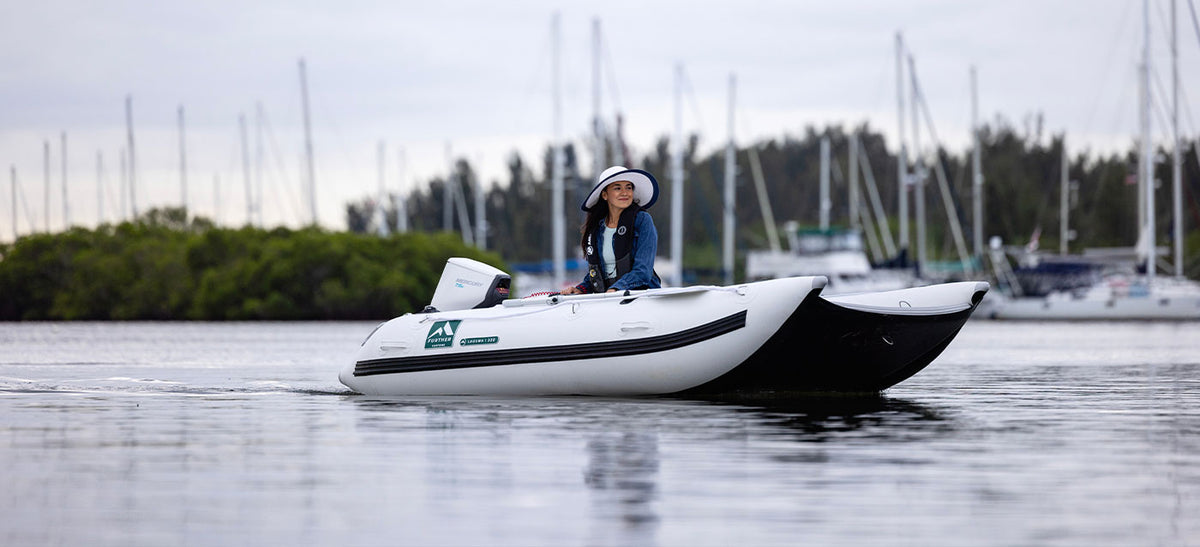
In light to moderate chop, an inflatable catamaran feels distinctly different from a conventional inflatable boat.
A V-hull attempts to cut through the chop and redirect water to either side. A catamaran tends to follow the contours of the water, rising and falling as the twin bows travel over successive waves.
That means passengers may feel the boat moving vertically more often, particularly in short, closely spaced chop. However, the wide stance of the twin tubes provides excellent lateral stability, so the movement tends to be more up and down rather than side to side.
This combination of buoyancy and lateral stability is one of the characteristics that makes the catamaran hull particularly comfortable for passengers moving around the boat, carrying gear, fishing, or using the boat as a tender.
Weight Distribution and Throttle Control Are Critical in Waves
Proper weight distribution is important in any inflatable boat, but it becomes especially important when operating an open-bow catamaran in waves.
Passengers, coolers, batteries, fuel tanks, and other heavy gear should generally be positioned toward the middle or stern of the boat rather than concentrated at the bow. Keeping excess weight out of the front allows the buoyant bow tubes to rise naturally as they encounter an approaching wave.
Too much weight at the bow can work against this natural lift, causing the bow to sit lower and increasing the chance of spray or water coming over the front. Proper weight distribution keeps the bow light, improves handling, and helps the catamaran glide up and over waves.
Throttle control is equally important. When approaching a larger wave, establishing the appropriate speed before reaching it creates forward momentum and helps raise the bow. With the bow elevated, the catamaran can climb the face of the wave and glide over the crest rather than driving directly into it.
Accelerating only after the bow has already entered the wave is less effective because the bow may already be loaded by the water.
A good rule to remember is: keep the weight centered or toward the stern and establish the appropriate speed before reaching the wave so the bow has the lift it needs to ride over it.
As with any small boat, speed should always be adjusted for the size, spacing, and steepness of the waves. More throttle is not necessarily better, particularly in steep or closely spaced chop.
Can an Inflatable Catamaran Handle Surf?
Yes. An inflatable catamaran can handle surf from both the bow and stern. When riding with the waves, the wide twin-hull design behaves much like an extra-wide surfboard, providing excellent stability as the boat moves across the face of a wave. The large pontoons resist side-to-side rolling, while the upward-sloping rocker of the dropstitch floor helps the hull rise and glide over the water rather than dig in.
Which Is Better in Rough Conditions: an Inflatable Catamaran or V-Hull?
Neither hull design is inherently better in every condition. They simply interact with waves differently.
A traditional V-hull cuts through and displaces water, which can provide a smoother ride with less vertical movement through light to moderate chop. However, penetrating the face of a wave can also create more bow spray.
An open-bow inflatable catamaran takes a different approach, using its buoyant twin bows to generate lift and ride over approaching waves. This can create slightly more up-and-down movement in rough conditions, but the wide twin-hull design provides exceptional lateral stability with significantly less roll and side-to-side movement. Because the bow rises over waves rather than driving through them, the ride can also remain remarkably dry through heavy chop and surf.
This hull design is at the heart of our Laguna Inflatable Catamaran, which combines an open bow, upward-sloping rocker, and large twin pontoons to create a stable and capable platform for exploring everything from calm lakes and bays to coastal waters and surf.
With proper weight distribution and throttle control, the combination of buoyancy, stability, and a dry open-bow design makes inflatable catamarans particularly well suited for recreational boating, yacht tender use, and coastal exploring.
In simple terms, a traditional V-hull can provide a smoother ride through small chop, while an inflatable catamaran may experience slightly more lift and pitch in challenging conditions because it rides over waves rather than cutting through them. With proper weight distribution and throttle control, however, its wide twin-hull design provides exceptional stability with significantly less roll and side-to-side movement.
Shop Collections