
Drop-Stitch Construction Explained: Why It Matters for SUPs & Inflatable Boats
Drop-stitch construction is a fabric technology that connects two layers of material with thousands of internal threads, allowing an inflatable product to be pumped up to high pressure (often 15-20+ PSI) while staying flat and rigid instead of ballooning like a pool toy. It's the reason a modern inflatable paddle board or inflatable boat floor can feel almost as stiff as a hard-sided hull.
If you've ever wondered why some inflatables feel like a rigid deck underfoot while others flex and wobble, drop-stitch construction is usually the answer.
What Is Drop-Stitch Construction?
Traditional inflatable platforms - pool floats, cheap rafts - are single-chamber air bladders. Pump them up too far and they balloon into a rounded shape, because nothing is holding the top and bottom surfaces apart except air pressure pushing outward in every direction.
Drop-stitch fabric solves this with an internal structure: two fabric layers (top and bottom) are joined by tens of thousands of short polyester or nylon threads, woven or "dropped" vertically between them during manufacturing. When the chamber is inflated, those internal threads pull taut and hold the top and bottom skins parallel to each other, distributing pressure evenly across a flat plane rather than letting it bulge outward.
The result: a board or floor that stays flat, rigid, and load-bearing at high pressure, rather than curving into a tube or dome shape.
Woven vs. Knitted Drop-Stitch
Not all drop-stitch fabric is built the same way, and the difference affects both rigidity and price.
|
Type |
How It's Made |
Strength |
Typical Use |
|
Woven drop-stitch |
Threads are mechanically woven through both fabric layers in a fixed pattern |
Higher tensile strength, more consistent rigidity at high PSI |
Premium paddle boards, high-performance inflatable boat floors |
|
Knitted (needle-loomed) drop-stitch |
Threads are looped through the fabric rather than woven |
Lower cost, slightly more flex at the same pressure |
Budget/entry-level inflatables |
Woven drop-stitch is generally considered the stronger, more dimensionally stable option, which is why it shows up most often in boards and boat floors built for higher weight capacities and rougher water.
Glued vs. Thermal-Welded Seams
Drop-stitch fabric handles the internal structure, but the seams - where panels are joined at the edges - matter just as much for long-term durability.
- Glued seams use adhesive to bond panel edges. They're cheaper to produce but more prone to seam failure over time, especially with UV and saltwater exposure, since the adhesive bond can degrade.
- Thermal-welded seams use heat and pressure to fuse PVC layers into a single continuous piece of material, rather than bonding two separate pieces together. This creates a stronger, more UV- and salt-resistant seam that holds up better over years of use.
Thermal-welded construction is generally the standard for higher-end inflatable catamarans and boats, since it removes the weakest point (the adhesive) from the equation entirely.
Why Drop-Stitch Matters for Paddle Boards
On a paddle board, rigidity translates directly into performance:
- Tracking and glide - a flexing board wastes paddle energy on deck flex instead of forward motion.
- Stability - a rigid deck gives you a more predictable, stable platform, especially important for beginners or anyone standing off-center.
- Weight capacity - higher PSI ratings (made possible by woven drop-stitch) generally support more weight without the board bowing in the middle.
- Packability - despite the rigidity when inflated, drop-stitch boards still roll down small for storage and transport, which is the whole appeal of an inflatable SUP over a hard board.
Why Drop-Stitch Matters for Inflatable Boats and Catamaran Floors
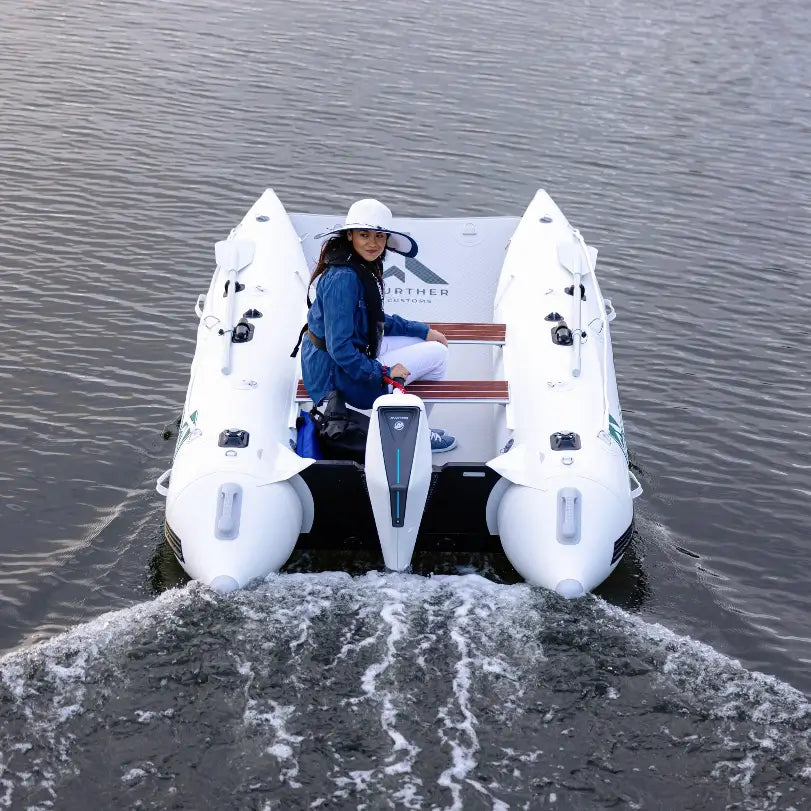
The same principle applies to inflatable boat floors and catamaran hulls, where the stakes are higher - you're not just standing on the material, you're relying on it for structural rigidity of the whole vessel.
- A dry, stable ride - a high-pressure drop-stitch floor keeps the hull rigid enough to cut through chop and wake instead of flexing and slapping.
- Load-bearing capacity - passengers, gear, coolers, and outboard engine weight all bear down on the floor; drop-stitch construction is what allows that floor to hold real weight without sagging.
- Performance under power - a rigid floor and hull transfer engine power into forward motion more efficiently than a soft, flexing structure would.
This is part of why inflatable catamarans with high-pressure, woven drop-stitch floors and thermal-welded seams are positioned as a step above basic dinghies - the construction is doing real structural work, not just holding air.
What to Look for When Buying
When comparing inflatable paddle boards or boats, a few construction details tell you more than marketing language alone:
- PSI rating - higher maximum PSI generally signals a stiffer, more capable board or floor (assuming it's paired with quality drop-stitch fabric).
- Woven vs. knitted drop-stitch - ask directly; manufacturers don't always volunteer this.
- Seam type - thermal-welded vs. glued. This is one of the biggest long-term durability factors.
- Sidewall construction - single-layer vs. double-layer, and whether sidewalls are reinforced, affects rigidity and puncture resistance separately from the drop-stitch core.
- Warranty length - a longer warranty is often a reasonable proxy for how confident a manufacturer is in their construction quality.
At Further Customs, we build every paddle board and inflatable boat around the same principle covered in this guide: real rigidity comes from real construction, not marketing claims. Whether you're comparing paddle boards or shopping for a full inflatable boat, take the time to ask about drop-stitch type and seam construction before you buy — it's the difference between gear that performs for years and gear that starts sagging after one season. That's the standard we hold ourselves to with every product we design.
FAQ
Is drop-stitch construction the same on all inflatable paddle boards? No. Quality varies significantly based on whether the drop-stitch is woven or knitted, how many threads per square inch are used, and whether seams are thermal-welded or glued. Two boards can look identical and perform very differently.
What PSI should an inflatable paddle board or boat floor be rated for? Higher-performance boards and boat floors are typically rated for 15-20+ PSI. Lower-pressure inflatables (often 8-12 PSI) will generally flex more underfoot and under load.
Does drop-stitch construction affect how much weight a board or boat can hold? Yes. A rigid, properly inflated drop-stitch floor distributes weight evenly across the surface, which is a major factor in a product's rated weight capacity.
Are thermal-welded seams worth paying more for? Generally, yes, for anything used regularly in saltwater or strong sun. Glued seams are more prone to degrading over time, while thermal-welded seams fuse the material itself and hold up better long-term.
Can drop-stitch fabric be repaired if it's punctured? Yes, most drop-stitch inflatables can be patched with a proper marine-grade PVC repair kit, similar to repairing any other inflatable. For instructions on how to properly repair a puncture or leak visit the following blog link: How to Repair Inflatables After Puncture or Leak