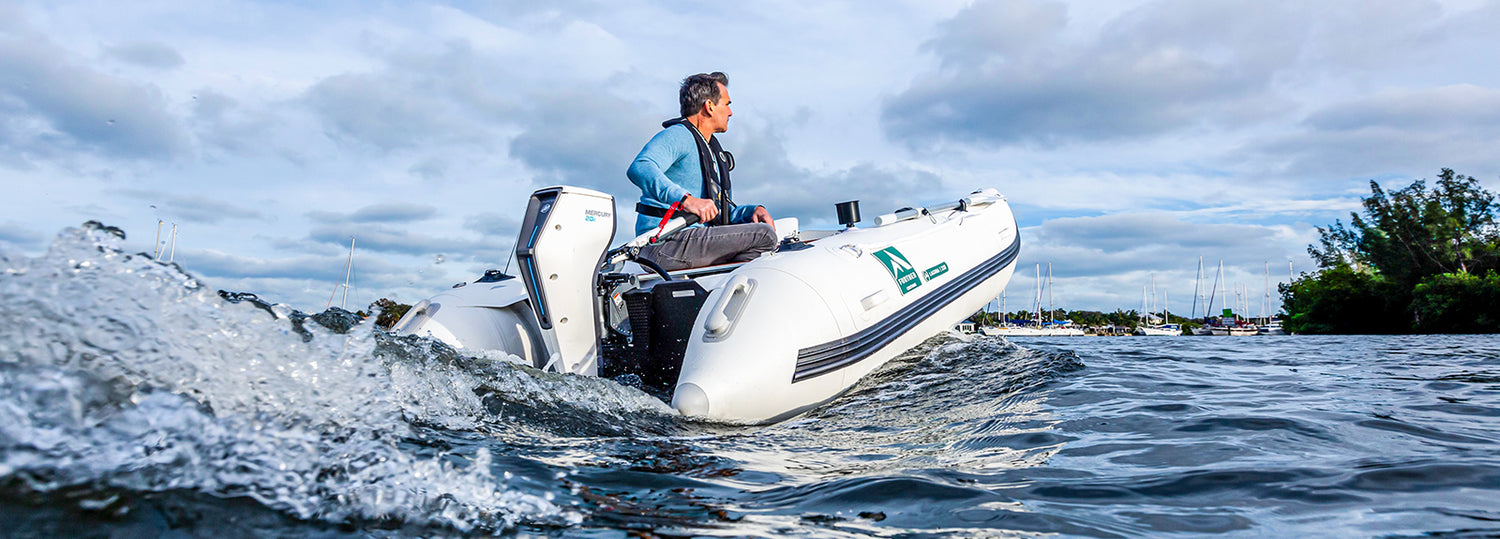
Choosing the right size outboard motor for an inflatable boat, catamaran, tender, or dinghy isn't simply a matter of buying the most horsepower your boat can handle.
The right engine depends on the size and design of your boat, passenger load, desired speed, operating conditions, and how much weight you're comfortable transporting. Finding the right balance can make your inflatable boat faster, easier to handle, and more enjoyable to use.
Start With How Much Weight You'll Carry
Passenger and cargo weight have a major impact on how an inflatable boat performs.
A motor that feels powerful with one person aboard may perform very differently after adding another passenger, a cooler, fishing equipment, fuel, and other gear.
The more weight you regularly carry, the more horsepower you'll generally want.
If you primarily boat alone, a smaller outboard may provide all the performance you need. If you regularly bring family, friends, pets, or equipment, additional horsepower can help compensate for the heavier load.
This becomes particularly important if your goal is to get an inflatable boat on plane.
Do You Need Your Inflatable Boat to Plane?
Planing is one of the biggest factors when deciding what size outboard motor to buy.
At lower speeds, your boat travels through the water in displacement mode. As speed and power increase, the hull can rise and travel across the surface of the water, or "get on plane."
Once on plane, an inflatable boat can travel significantly faster and more efficiently at higher speeds.
If you're happy cruising slowly, you may need considerably less horsepower.
If getting on plane is important, you'll want enough power to overcome the combined weight of the boat, passengers, engine, fuel, and gear.
Consider the Length and Design of Your Inflatable Boat
Boat size matters, but length isn't the only consideration.
Hull design, width, tube diameter, total weight, transom design, and passenger capacity all influence how much horsepower an inflatable boat can effectively use.
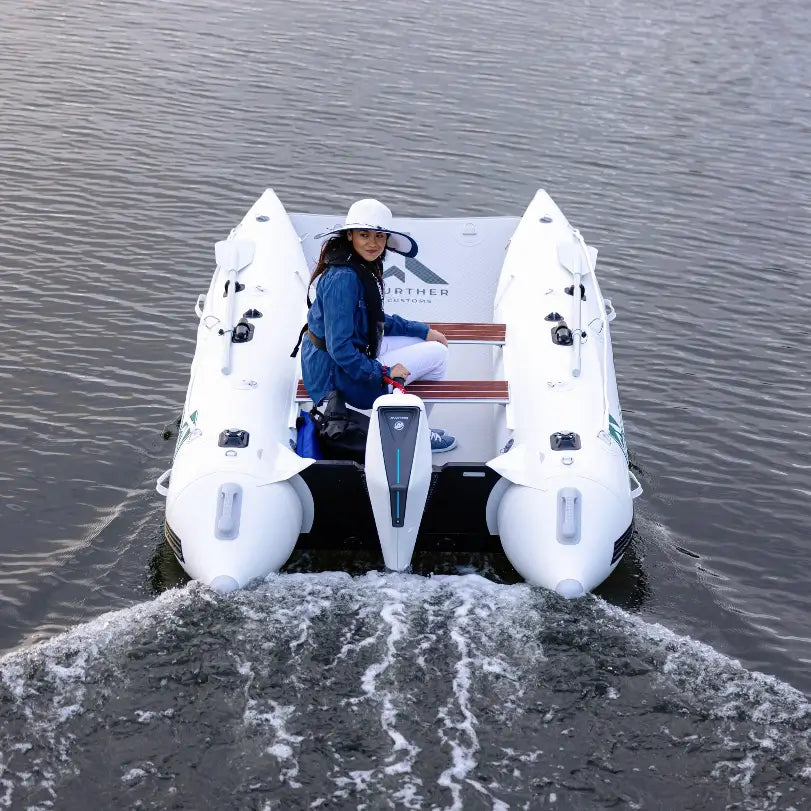
An inflatable catamaran, for example, behaves differently from a conventional inflatable dinghy. Catamaran-style hulls can provide excellent stability and efficient planing performance because of their twin-hull design.
A longer inflatable boat may also perform better under load because it provides additional buoyancy and distributes weight across a larger hull.
This is why two inflatable boats with similar maximum horsepower ratings can perform very differently with the same engine.
More Horsepower Also Means More Weight
One of the most overlooked factors when choosing an outboard motor is the weight of the engine itself.
Typical modern four-stroke gas outboards weigh approximately:
-
6 HP: 50–60 lbs
-
8 HP: 84–92 lbs
-
9.9 HP: 84–97 lbs
-
15 HP: 95–111 lbs
Exact weights vary by manufacturer, shaft length, and configuration.
The jump from a 6 HP to an 8 or 9.9 HP outboard is particularly important for owners of portable inflatable boats. You may gain additional performance, but you could also add approximately 30 pounds to an engine that you'll need to lift, transport, store, and mount.
A 15 HP outboard can exceed 100 pounds, making it considerably more difficult for one person to handle.
How Heavy of an Outboard Can You Comfortably Carry?
Horsepower matters when you're on the water. Engine weight matters everywhere else.
Think about everything that happens before and after your trip.
Will you lift the motor into the back of an SUV or truck? Carry it down a dock? Move it across a beach? Store it in your garage or RV? Mount it to the transom without assistance?
For many inflatable boat owners, portability is one of the main reasons they chose an inflatable in the first place.
A more powerful motor isn't necessarily an upgrade if its additional weight makes your boat significantly more difficult to use.
Our general rule is to choose the largest outboard within your boat's horsepower rating that you can comfortably transport and handle.
Think About Where You'll Be Boating
Your environment should also influence your choice of outboard motor.
Protected lakes and harbors generally require less power than coastal environments where wind, waves, and current can affect performance.
For relaxed lake cruising, a smaller outboard may be more than sufficient.
For coastal exploration, carrying multiple passengers, or traveling longer distances, having additional power in reserve can be valuable.
This doesn't mean you should automatically choose the largest motor available. It means your engine should be sized for the conditions you realistically expect to encounter.
Don't Forget About Weight Distribution
Outboard weight doesn't simply affect portability. It also changes how your inflatable boat sits in the water.
A heavy motor places additional weight directly on the stern. Add a fuel tank, driver, and gear toward the back of the boat and the stern can become disproportionately loaded.
Proper weight distribution can make a noticeable difference in acceleration, planing, handling, and overall performance.
If you're having difficulty getting an inflatable boat on plane, the solution isn't always more horsepower. Moving passengers or equipment forward can sometimes make a substantial difference.
Gas or Electric Outboard?
Both gas and electric outboard motors can work extremely well with inflatable boats.
Gas engines generally provide the greatest combination of speed, range, and power for boaters who want to get on plane or travel longer distances.
Electric outboards are particularly attractive for shorter trips, yacht tender use, lakes, harbors, fishing, and recreational cruising where quiet operation and convenience are more important than maximum speed.
Rather than choosing based on horsepower alone, consider the complete propulsion system, including the weight of the motor, fuel or batteries, desired range, and how you'll transport everything.
Always Follow Your Boat's Maximum Horsepower Rating
Every inflatable boat has limits.
The manufacturer's maximum horsepower rating accounts for factors such as hull construction, buoyancy, transom strength, handling, and overall boat design.
Never exceed the maximum horsepower rating specified by the manufacturer.
However, remember that maximum horsepower is a limit, not necessarily a recommendation.
A boat rated for a 15 HP outboard doesn't mean every owner needs 15 HP. Depending on your passenger load and desired performance, a smaller and lighter engine may provide a better overall experience.
So, What Size Outboard Should You Choose?
Start with your typical day on the water rather than the maximum number printed on the boat.
If you primarily cruise at relaxed speeds with one or two people, a smaller, lighter outboard may be all you need.
If you regularly carry multiple passengers, want to get on plane, or explore farther from your launch point, additional horsepower will become more important.
Most importantly, consider the complete package: boat size, passenger load, engine weight, desired speed, operating conditions, and portability.
The best outboard motor for an inflatable catamaran, tender, or dinghy isn't necessarily the largest one it can handle. It's the engine that delivers the performance you want without sacrificing the portability that makes an inflatable boat so convenient in the first place.