ePropulsion Electric Outboard Motors
Small, Packable Electric Boat Motors for Your Next Adventure
Explore electric outboard motors from leading brands including ePropulsion, Torqeedo, Mercury and Remigo for inflatable boats, dinghies, tenders and small vessels. Enjoy quiet, efficient propulsion with no exhaust emissions during useExplore small electric outboard motors designed for convenient transport, easy storage, and quiet days on the water. Our collection of ePropulsion eLite, Spirit 1, and Spirit 2 electric boat motors offers compact options for inflatable boats, dinghies, and yacht tenders. Whether you're making ship-to-shore trips, exploring sheltered bays, or cruising freshwater lakes, find a portable electric outboard that fits your boat, onboard storage, and travel plans., rechargeable battery options and portable designs suited to ship-to-shore trips, lake outings and coastal cruising. Whether you prioritize lightweight handling, greater power or longer range, compare motor and battery configurations to find the right electric propulsion system for your boat.
Filters
3 products




Perfect for Ferrying & Short Adventures
ePropulsion eLite
Perfect for short trips in calm waters, the eLite excels on dinghies, inflatable boats, and yacht tenders used around marinas, docks, gentle rivers and freshwater lakes. This 500W electric outboard engine includes a 378Wh integrated battery, 360° steering, quick-release bracket, and 100W solar charging. Ideal for harbor ferrying, it’s ultra-light, simple to use, and easy to store—perfect for boaters who value portability.
Shop eLite
Best All-Around Electric Outboard for Inflatable Boats and Coastal Cruising
ePropulsion Spirit 1.0 Plus
Ideal for eco-conscious boaters using inflatable boats, dinghies, or tenders on lakes, harbors, and coastal waters, the 2025 Travel S delivers 1,100W of quiet, efficient power. Features include 360° steering, a no-cable click-in battery, app integration, and 200W solar support. It’s one of the smartest and most flexible electric outboard motors available, built for performance and modern convenience.
Shop Spirit 1.0More Power & Range for Coastal and Multi-Day Use
ePropulsion Spirit 2
The ePropulsion Spirit 2 electric outboard motor combines 2 kW of continuous power with a removable 1,539 Wh battery for inflatable boats, dinghies, and yacht tenders. The tiller version adds a 3 kW Boost Mode for up to one minute when battery and temperature conditions allow. A cable-free, quick-connect battery, detachable transom clamp, and folding tiller simplify setup, transport, and onboard storage. A full-color display, adjustable tiller positions, and shallow-water trim provide convenient control, while hydrogeneration allows compatible sailing setups to recharge the battery underway.
Shop Spirit 2.0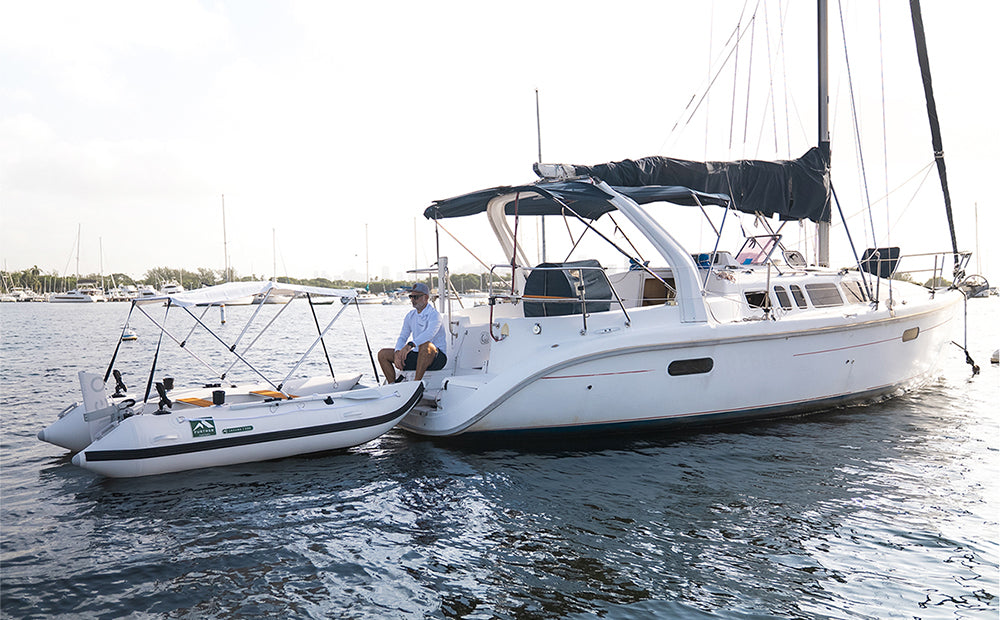
Explore our inflatable catamaran tenders.
Looking for a Lightweight Vessel to Pair with Your Electric Motor?
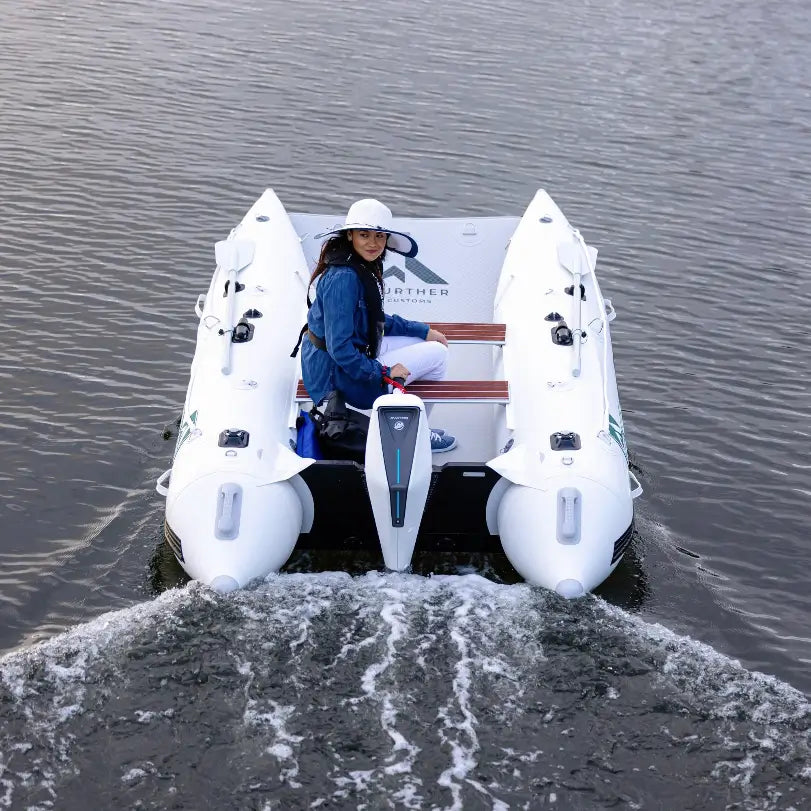
Pair your electric outboard with a lightweight inflatable catamaran tender for a portable, easy-to-store setup built for life on the water. Save when you purchase your motor and inflatable tender together as a complete package.
Shop Exclusive Engine Package DealsCompare Electric Outboard Engines
All four of these electric outboard motors are well-suited for powering small inflatable boats, but each offers unique advantages. The ultra-light ePropulsion eLite is ideal for quick marina transfers, small lakes and easy storage. The Spirit 1.0 provides extended range and power for longer trips. The Mercury Avator 7.5e delivers a refined user experience with a quick-release mount and the backing of Mercury’s global support network. Compare below to find the best electric motor for your vessel.
Short Marina Runs, Ferrying, Calm Rivers & Small Lake Cruises
Longer Marina Runs, Calm Coastal Passages & Bay Cruising through Light Chop
Yacht-to-Shore Tendering, Gasoline Restricted Waters, Marina Runs & Leisure Cruising
500W
1,000W
2,000 W continuous (3,000 W Boost Mode for up to 60 seconds)
378Wh (Built In)
1,276Wh (Removable)
1,539 Wh
14.7 lbs (Engine) 17.4 lbs (Engine + Transom Brack)
42.6 lbs Total - 23.4 lbs (Engine Only) + 19.2 lbs (Battery Only)
51 lbs Total - 22.9 lbs (Engine Only) + 22.9 lbs (Battery Only) + 5.3 (Transom Bracket)
360 Rotation & Quick-Release Transom
Standard Tiller
Digital Throttle & Quick Release Transom
Up to 100W
180W
Up to 400W
Power Output, Battery Level, Battery Health (Monochrome LCD)
Power Output, Battery Level, Battery Health + Estimating Time or Range Remaining (Monochrome LCD)
Power Output, Battery Level, Battery Health + Estimating Time or Range Remaining + Speed (Full Color Digital Display)
Lightest All-In-One Electric Outboard with Built-In Battery & Quick-Release Transom Bracket
Longest Range with Standard Battery, Solar Charging Capability & Floating Battery
Detachable Transom clamp, a 90° folding tiller that doubles as a carrying handle. The tiller offers four locking positions and a 13.5 cm extension.
Your Questions About Electric Boat Motors, Batteries & Range Answered
ePropulsion Electric Outboard Motors: Frequently Asked Questions
Explore answers to common questions about ePropulsion electric outboard motors, including the eLite, Spirit 1, and Spirit 2. Learn about battery life, charging options, power, portability, and choosing the right motor for your inflatable boat, dinghy, or yacht tender. Need more guidance? Contact our team by text, live chat, or through our contact page for personalized assistance.
Which ePropulsion electric outboard motor is right for my boat?
The eLite is a compact choice for short dinghy trips and light loads. The Spirit 1.0 offers more power and battery capacity for regular tender use and relaxed cruising. The Spirit 2 suits boaters seeking additional power, a larger battery, and features such as a full-color display and quick-connect battery. Your boat’s size, passenger load, and typical travel distance help determine the best fit.
How much power do the eLite, Spirit 1, and Spirit 2 provide?
The eLite delivers 500 W of continuous power with a temporary 750 W Sport Mode. The Spirit 1.0 delivers 1,000 W, while the Spirit 2 provides 2,000 W continuously. The Spirit 2 tiller version also offers 3,000 W Boost Mode for up to one minute, subject to battery charge and temperature conditions.
How do their battery capacities compare?
The eLite features a built-in 378 Wh battery. The Spirit 1.0 Plus and Evo use a removable 1,276 Wh battery, while the Spirit 2 uses a removable 1,539 Wh battery. A larger battery stores more energy, giving you greater flexibility for longer outings when operated at economical speeds.
Can I charge an ePropulsion outboard using solar panels?
Yes, solar charging options are available for the eLite, Spirit 1.0, and Spirit 2 with the appropriate model-specific charger and compatible panels. Panels and charging accessories are purchased separately, and charging speed varies with sunlight and panel setup.
Can I carry a spare battery for longer trips?
The Spirit 1.0 and Spirit 2 feature removable batteries, so you can carry a compatible spare and swap batteries to extend your time on the water. However, the eLite has a built-in battery that cannot be swapped out like the Spirit batteries.
How do I choose the correct shaft length?
Measure your boat’s transom height and compare it with the installation guidance for the specific motor. Shaft labels are not interchangeable across every outboard brand or model. Correct installation keeps the propeller adequately submerged for effective propulsion. Our Laguna inflatable catamaran kit has a 15" transom and is compatible with the short shaft length.
What is an electric outboard motor and how does it work?
An electric outboard motor is a propulsion system powered by a rechargeable battery instead of gasoline. It uses a brushless or direct-drive electric motor to rotate a propeller, offering quiet, clean, and efficient thrust for boats such as dinghies, tenders, inflatables, kayaks, and small sailboats. Most modern models feature integrated or swappable lithium-ion batteries, intuitive tiller or remote control, and simple plug-and-play operation.
What types of boats are electric outboards best suited for?
Electric outboards are ideal for inflatable boats, dinghies, yacht tenders, kayaks, catamarans, and other small watercraft used in harbors, lakes, and coastal areas. They're especially useful for shore transfers from anchored or moored boats, such as those visiting Catalina Island, Two Harbors or other nearshore destinations. Many boaters also use them on freshwater lakes where gas engines are restricted or discouraged.
How long does the battery last on an electric outboard?
Electric outboard engines deliver impressive efficiency at lower throttle levels, but their range decreases rapidly as speed increases—a dynamic known as exponentially diminishing returns. This is due to the way water resistance (drag) scales with speed. When you double your throttle, you’re not simply using twice the power—you may be using three to four times more energy, especially as you approach top speed.
As a result, cruising at full throttle can drastically reduce your runtime, sometimes cutting it about an hour. In contrast, operating at quarter or half throttle dramatically extends battery life, often allowing for 4–6 hours of continuous use or over 15 miles of range on a single charge. For boaters using dinghies, tenders, or inflatable boats to ferry to shore or travel between moorings, maintaining a moderate cruising speed offers a smart balance of efficiency, performance, and range—especially when you're off-grid or relying on solar recharging.
Key takeaway: To maximize the performance of your electric outboard, aim to operate at 50% throttle or less whenever possible. This sweet spot provides exceptional range and preserves battery health, making it ideal for long days on the water or when carrying a spare battery for extended outings.
How fast can an electric outboard motor go?
Speed varies by motor output and vessel type, but most electric outboards in the 500W–1,100W range reach speeds between 3 to 6 knots (3.5–7 mph). High-performance models may reach up to 8–10 knots on light planing hulls. For dinghies, tenders, and inflatables, this is more than enough for short-range commuting or harbor navigation.
Do electric outboard engines require maintenance?
Very little. Electric outboards are virtually maintenance-free. There are no oil changes, spark plugs, impellers, or fuel systems to service. Most models require only occasional rinsing, battery care, and basic inspections. This is a major advantage over gas outboards, which often need carburetor cleaning, engine flushing, and regular tune-ups.
How do you charge an electric outboard motor?
Electric outboards charge via AC wall outlets or 12V/24V DC sources, and many support solar charging. Charging time depends on battery size and charger speed. Some models support fast charging or have optional high-output chargers. Solar charging is ideal for off-grid use, especially when anchored for multiple days.
Can the electric engines get a boat on plane?
Most electric outboard engines in the 500W to 1,100W range are designed for displacement speeds, making them ideal for dinghies, tenders, and inflatable boats used for short-distance cruising, harbor transport, or ferrying to shore. These motors are not intended to bring a boat onto plane, which requires significantly more thrust and speed than electric systems in this category typically offer.
For those seeking planing performance, only higher-powered electric models—such as the ePropulsion Navy series or Torqeedo Cruise series in the 3kW to 10kW range (roughly 6–20HP equivalent)—have the capability to plane a small, lightweight hull. However, the combination of large motors, heavy battery banks, and high voltage systems often makes these setups cost-, space-, and weight-prohibitive, especially for portable or inflatable boat applications.
For this reason, if achieving planing speed is a priority, we recommend a minimum of a 6HP engine when pairing with any inflatable or RIB. In many cases, an 8HP or larger engine is more effective, especially when carrying multiple passengers or gear, or when operating in choppy or tidal conditions.
In general, we advise choosing the largest engine size a user can comfortably lift and mount on their boat’s transom. This not only ensures better speed and range but also improves overall handling and responsiveness, particularly when using the vessel as a primary tender, island hopper, or shore shuttle. For those prioritizing performance, range, and versatility—especially when getting on plane is desired—a lightweight gas engine in the 6–15HP range remains the most practical solution.
How are electric outboards easier and safer to store and transport?
Yes—and they offer major advantages over gas-powered outboards when it comes to storage, safety, and cleanliness.
Most electric outboard motors are not only lighter and more compact, but they can also be safely stored in enclosed spaces like boat lockers, cabin hatches, RVs, or even indoors—something that’s never recommended with gas engines due to flammable fuel, lingering odors, and the risk of vapor buildup. Since there’s no gasoline or oil involved, you’ll never deal with fumes leaking into your boat cabin, fuel smells soaking into your vehicle, or hazardous storage conditions on board.
Electric motors often break down into two components: the battery and the motor unit, making them even easier to lift, carry, and stow in tight compartments. This makes them particularly appealing for catamarans, cruisers, and sailboats where locker space is limited and fuel storage can create safety concerns.
And unlike gas engines that must be stored upright to avoid leaking, many electric outboards can be safely stored on their side, transported in a car, SUV, or truck, and even kept inside a home or apartment without worry. They're ideal for people who live in condos, boat out of shared marinas, or travel with their outboard between destinations.
Key benefits:
- No fuel leaks, vapors, or lingering odor
- Safe for indoor and enclosed storage (homes, lockers, hatches)
- Lightweight and modular for easy lifting and transport
- Perfect for RVs, vans, and vehicle trunks
- No upright-only storage constraints like gas motors
For boaters who value safety, cleanliness, and flexibility—especially in tight or shared spaces—electric outboards are the most convenient and user-friendly option available today.
Are electric outboards worth the investment?
Though the upfront cost can be higher than small gas motors, electric outboards save money over time by eliminating fuel costs, engine maintenance, and service downtime. They’re especially cost-effective for boaters who use their tender regularly, cruise off-grid, or want a reliable, always-ready propulsion system with minimal upkeep.
Shop Electric Outboards


Blog posts

How Fast Can an Inflatable Catamaran Go?
From quiet electric cruising to 20+ mph with a gas outboard, inflatable catamarans can deliver impressive performance from relatively modest horsepower. How fast an inflatable catamaran can go depe...
Electric Boat Motors Explained: kW vs HP, Range and Best Uses
Electric boat motors are rated in kilowatts (kW), not horsepower (HP), which trips up most first-time buyers. The quick conversion is 1 kW ≈ 1.34 HP, so a 3 kW electric outboard performs roughly li...

Buying an Electric Tender Boat? Here's a Checklist to Follow
The shift toward electric modes of marine transportation is happening now, with electric tender boats paving the way. With no emissions, noise-free operation, and low upkeep, electric tenders are r...