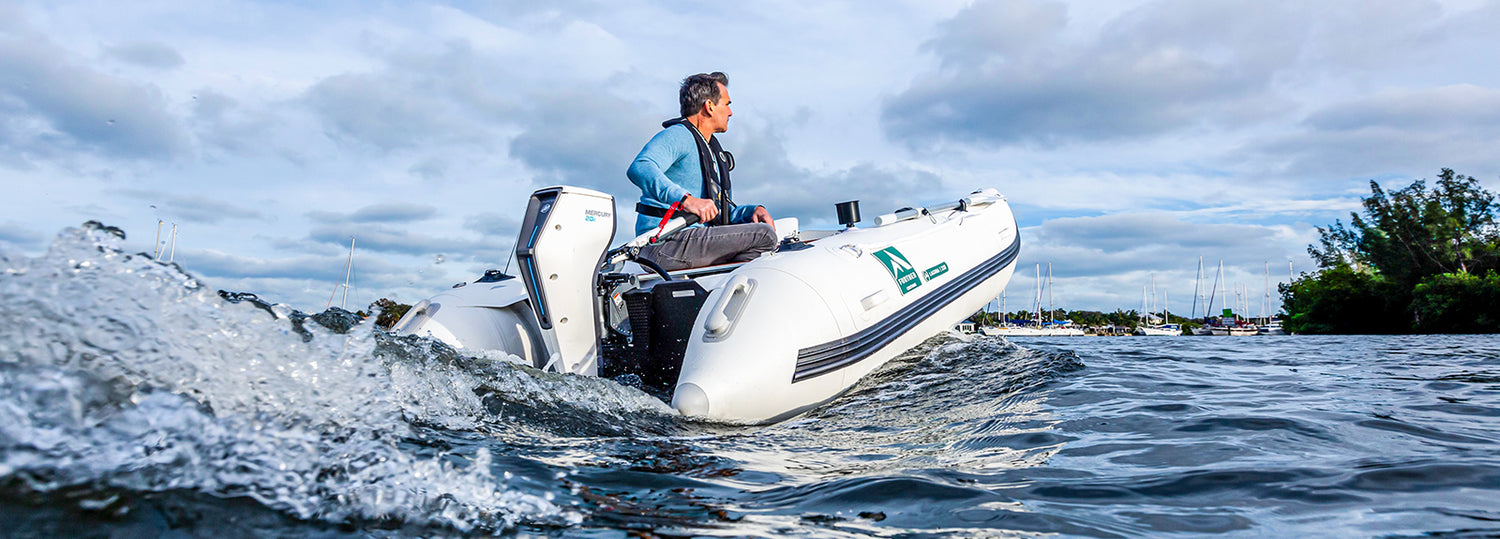
A boat tender is a small, secondary boat used to ferry people, gear, and supplies between a larger vessel (a yacht, sailboat, or mooring) and the shore. Tenders are typically light enough to be stowed on deck, towed behind, or carried in davits, and they exist because most large boats can't dock directly at a beach, shallow marina, or informal anchorage.
If you own — or are thinking about buying — a yacht, sailboat, or any boat that anchors offshore, a tender isn't a luxury add-on. It's the piece of equipment that actually gets you (and your dog, cooler, and dive gear) from the boat to land and back.
This guide covers what tenders are, the main types available in 2026, how they compare, and a framework for choosing the right one for your boat.
Why You Need a Tender
If your main boat can anchor in open water, tie up to a mooring ball, or sit off a beach with no dock access, a tender is your only way to reach shore. Common uses include:
- Shore access — getting from an anchorage to a beach, dinghy dock, or restaurant
- Provisioning runs — picking up groceries, fuel, or supplies without moving the main vessel
- Diving and snorkeling — many divers use a tender as a dedicated dive platform
- Fishing — a tender lets you fish shallow water or explore creeks the main boat can't reach
- Exploring — mangroves, coves, and sandbars that are inaccessible to a deep-draft yacht
- Emergency backup — a second means of getting to shore if needed
Boat Tender vs. Dinghy: Is There a Difference?
Most boaters use "tender" and "dinghy" interchangeably, and in casual conversation that's fine. Technically:
- A dinghy refers to the boat itself — its hull type and size class.
- A tender refers to the boat's function — a small craft that serves a larger vessel.
In other words, a dinghy that's used to service a yacht is a tender. Not every dinghy is a tender (some are used as standalone recreational boats), but every tender is some form of dinghy, RIB, or inflatable.
Types of Boat Tenders
There are four main categories of tenders on the market today. Each has a different balance of stability, portability, storage footprint, and cost.
1. Traditional Hard-Shell Dinghies
Small fiberglass or aluminum boats with a single rigid hull.
- Pros: Simple, durable, no inflation required, often inexpensive used
- Cons: Heavy for their size, hard to stow on deck, limited stability, dents/scratches damage the hull permanently
2. Rigid Inflatable Boats (RIBs)
A rigid fiberglass or aluminum hull with inflatable tubes around the sides.
- Pros: Good speed and handling, tubes add buoyancy and some stability, popular with larger yachts
- Cons: Heavier and bulkier than a fully inflatable boat, harder to deflate/stow, higher cost, still uses a single-hull (monohull) design underneath — so it can still feel tippy at rest compared to a catamaran hull
3. Traditional Inflatable Boats (Monohull Inflatables)
Fully inflatable, single-tube-around-a-V-hull design.
- Pros: Lightweight, packs down small, affordable
- Cons: Less stable standing up, softer floor unless upgraded to an air-deck, single-hull shape still rolls side to side more than a catamaran hull
4. Inflatable Catamaran Tenders
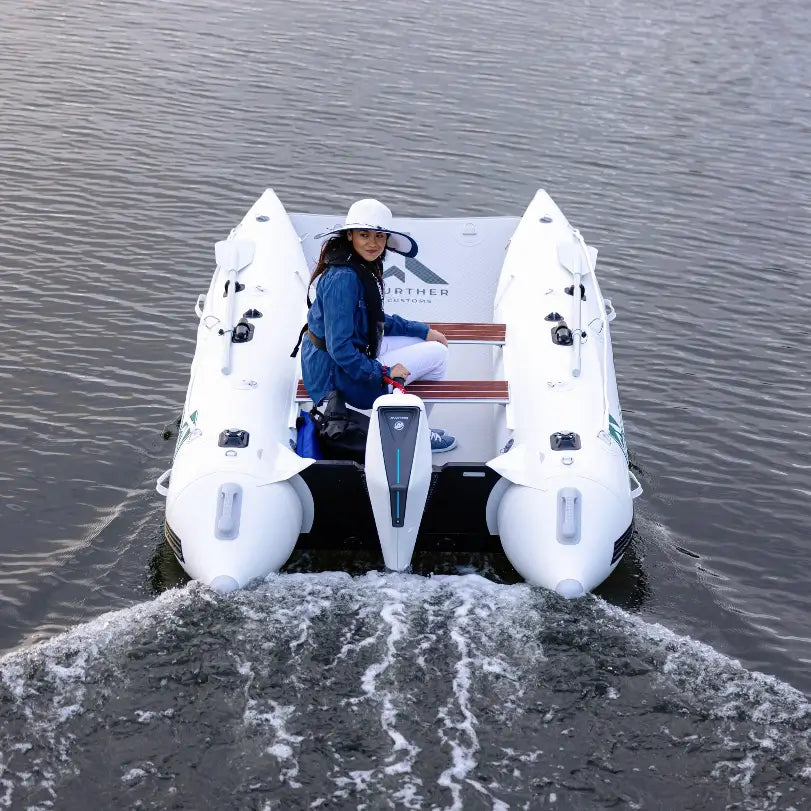
A dual-hull (catamaran) inflatable design — the category Further Customs specializes in.
- Pros: Significantly more stable at rest and underway because the load is spread across two hulls instead of one, packs down for easy storage, lighter than a comparable RIB, easier to launch and retrieve, works well with small electric or gas outboards
- Cons: Higher price point than a basic monohull inflatable, less common secondhand market
Tender Type Comparison
| Feature | Hard-Shell Dinghy | RIB | Monohull Inflatable | Inflatable Catamaran |
|---|---|---|---|---|
| Stability at rest | Low–Medium | Medium | Low–Medium | High |
| Weight | Heavy | Heavy | Light | Light–Medium |
| Storage/stowage | Difficult | Difficult | Easy (deflates) | Easy (deflates) |
| Durability | High (dents don't sink it) | High | Medium | High (multi-chamber, puncture-resistant) |
| Ease of towing/davits | Moderate | Good | Good | Good |
| Typical price range | $$ (used market varies widely) | $$$$ | $ | $$–$$$ |
| Best for | Budget, permanent marina slip | Larger yachts, speed | Casual, occasional use | Yacht tenders, standing/fishing/diving, dog owners |
Note: exact pricing and specs vary by brand, size, and outfitting — use this as a directional comparison, not a quote.
How to Choose the Right Tender for Your Boat
Work through these five questions before buying:
1. How will you store it? If you have davits or a large deck, a RIB may work. If you have limited space or need to deflate-and-stow in a locker or lazarette, an inflatable (monohull or catamaran) is the better fit.
2. Who's using it, and how? Standing to fish, diving off the side, or boating with kids and dogs all demand more stability than simply motoring to a dock. A catamaran hull's dual-hull design resists the side-to-side rocking that makes monohull inflatables and hard dinghies feel unstable.
3. What's your tow vehicle or mothership like? Weight limits on davits, tow capacity, and available deck space all narrow your options. Lighter inflatable designs open up more boats — including smaller sailboats — that couldn't otherwise carry a hard-shell dinghy or RIB.
4. What size outboard do you want to run? Lighter tenders (like inflatable catamarans) plane and perform well with smaller, often electric, outboards — which also means less noise, less maintenance, and no fuel smell in your storage locker.
5. What's your budget, including the outboard, oars, and accessories? Price the whole system, not just the hull. A cheap monohull inflatable that needs an oversized outboard to feel stable often costs more in the end than a well-designed catamaran tender that performs well with a smaller engine.
Quick Answers (FAQ)
Is a tender the same as a dinghy? Functionally, yes, in most conversations. Technically, "dinghy" describes the boat type, while "tender" describes its job of servicing a larger vessel.
What size tender do I need? It depends on how many people you regularly need to ferry and how much gear you carry. Most yacht owners size their tender to comfortably fit their full crew plus a cooler or dive gear, with margin for calm-water stability rather than max-rated capacity.
Are inflatable tenders safe? Modern inflatable tenders, especially multi-chamber catamaran designs, are built with separate air chambers so a single puncture won't sink the boat, and are rated and tested for load capacity like any other boat.
Do I need a license to operate a tender? Requirements vary by state and by the tender's motor size — check your state's boating authority before heading out.
The Bottom Line
A boat tender is any small boat used to service a larger vessel — but not all tenders are built the same. Hard-shell dinghies and RIBs are heavier and harder to stow; monohull inflatables are light but less stable; inflatable catamaran tenders combine the packability of an inflatable with the stability of a dual-hull design, making them a strong choice for yacht owners who want to stand, fish, dive, or bring the family (and the dog) ashore with confidence.
Ready to find your tender? Further Customs designs stable, lightweight Inflatable catamaran tenders built for exactly these use cases. Explore the full lineup at furthercustoms.com and find the right tender for your boat.